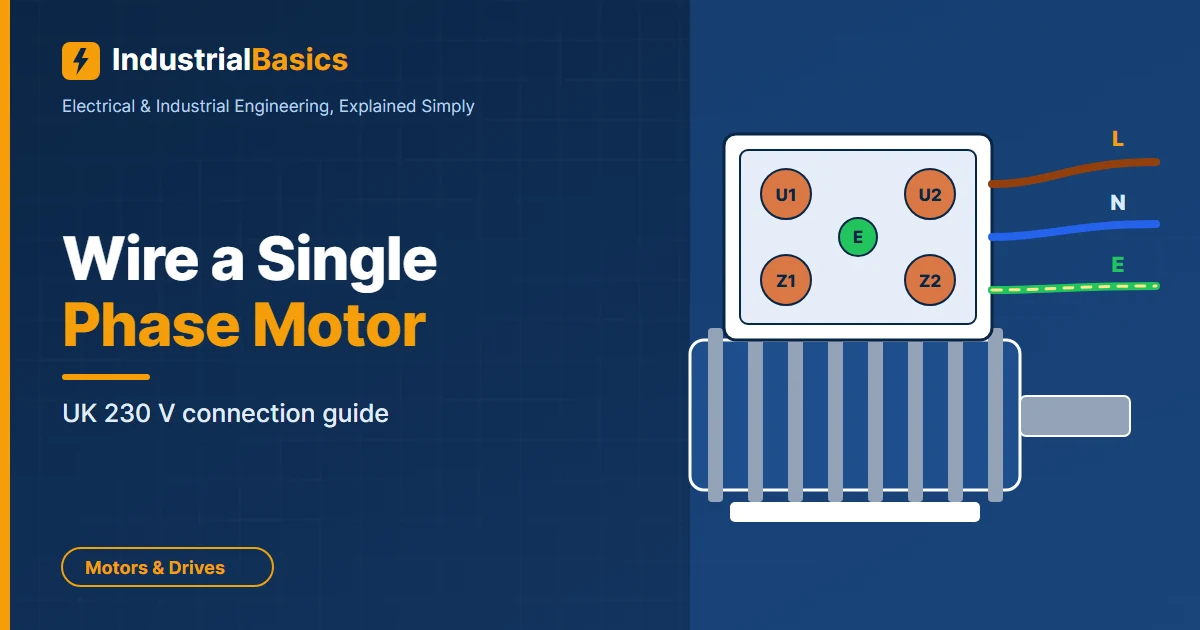
To wire a single-phase electric motor in the UK, isolate the supply, follow the diagram inside the terminal box lid, and connect line (brown), neutral (blue) and earth (green-and-yellow) to the marked points. Most capacitor motors have a main winding marked U1–U2 and an auxiliary winding marked Z1–Z2, set by metal links. To reverse the motor, change one winding relative to the other. Terminal layouts vary, so the diagram for your motor always takes priority.
| Item | UK marking or colour | Notes |
|---|---|---|
| Line | L, brown | 230 V supply conductor |
| Neutral | N, blue | Return conductor |
| Protective conductor | E or PE, green-and-yellow | Connect to the motor earth terminal |
| Main winding | Often U1–U2 | Check the motor diagram |
| Auxiliary winding | Often Z1–Z2 | Used with a capacitor circuit |
Read the Motor Before You Wire It
Start with the nameplate and the diagram inside the terminal box lid. UK supplier Rotor warns that incorrect wiring will damage the motor and invalidate the warranty. Check these details first:
- Voltage and frequency: the motor must suit a 230 V, 50 Hz supply.
- Power and full-load current.
- Motor type and capacitor values.
- The link positions for your required rotation.
- Whether the motor is reversible from the terminal box.
If you need help understanding the current rating, see our guide to full load amps.
Types of Single-Phase Motor
| Type | Auxiliary circuit | Typical behavior |
|---|---|---|
| Capacitor start | Start capacitor and centrifugal switch | Auxiliary circuit drops out as the motor speeds up |
| Permanent split capacitor | One run capacitor, no starting switch | Simple, with lower starting torque |
| Capacitor start, capacitor run | Start and run capacitors | Good starting and running performance |
| Shaded pole | Shading ring | Small motors, usually no capacitor |
In a typical capacitor-start motor, the centrifugal switch opens at about 75% of full speed. Shaded pole motors work differently and are covered in our shaded pole motor guide. If you need to identify a capacitor value, our guide to capacitor codes can help with small components.
How to Wire the Motor Step by Step
- Isolate and lock off the supply, then prove dead.
- Open the terminal box and photograph the existing connections.
- Find the wiring diagram inside the lid.
- Check the capacitor is discharged before touching its terminals.
- Bring the cable in through a suitable gland.
- Connect the protective conductor to the motor earth terminal.
- Connect line and neutral to the points shown on the diagram.
- Fit the links for the required direction.
- Tighten all terminals and refit the gasket and lid.
- Inspect and test before energizing, then check the direction with the load uncoupled where possible.
For protecting the terminal box after installation, see our guide to the motor terminal box. An insulation resistance test can confirm the winding condition.
How to Reverse a Single-Phase Motor
Rotation depends on the relationship between the main and auxiliary windings. To reverse the motor, reverse the connections of one winding, not both. Rotor’s connection sheets say to re-position the two metal links in the terminal box.
Simply swapping line and neutral at the supply reverses both windings together, so the direction stays the same. Some motors are non-reversible without being opened, because the auxiliary leads are not brought out. If your terminal box does not show a reversing arrangement, ask the manufacturer.
UK Protection and Control Requirements
BS 7671 Regulation 552.1.2 requires control equipment with overload protection for every motor rated above 0.37 kW. It does not apply to a motor built into equipment that complies as a whole with an appropriate British or harmonised standard. A fuse or breaker chosen to survive starting current may not protect a motor from overheating, so a separate overload device is often needed.
| Motor | Regulation 552.1.2 overload requirement |
|---|---|
| 0.25 kW standalone | Not triggered by the 0.37 kW threshold |
| 0.37 kW standalone | Not triggered, because the rating does not exceed 0.37 kW |
| 0.55 kW standalone | Required |
| 0.75 kW standalone | Required |
| Motor inside compliant equipment | May be excepted |
As a rough example, a 0.75 kW motor with an assumed 70% efficiency and 0.9 power factor draws about:
Use the nameplate current for the real design. Our guides to the thermal overload relay and motor starters explain the protection and control options.
Common Wiring Faults
| Symptom | Likely cause | Check after isolation |
|---|---|---|
| Hums but will not start | Capacitor, auxiliary circuit or seized load | Capacitor, switch, free rotation |
| Runs the wrong way | Links set for the other direction | Motor diagram |
| Trips on start | Wiring fault, overload or stalled load | Connections and insulation |
| Runs hot | Overload, wrong connection or voltage | Current and nameplate |
| Earth fault device trips | Insulation or wiring fault | Insulation resistance |
For repeat failures, see our guide to motor failure causes.
Frequently Asked Questions
How do you wire a single phase electric motor in the UK?
Isolate the supply, follow the diagram inside the terminal box lid, connect line, neutral and earth to the marked points, fit the required links, then test before energizing. The work must be done by a competent person.
What colours are UK single-phase motor wires?
For the supply, line is brown, neutral is blue and the protective conductor is green-and-yellow. Internal motor lead colours vary, so use the terminal markings.
What do U1, U2, Z1 and Z2 mean on a motor?
On many single-phase motors, U1 and U2 are the main winding and Z1 and Z2 are the auxiliary or start winding. Confirm this from the motor’s diagram.
How do I reverse a single-phase motor?
Reverse one winding relative to the other, not both. On many terminal boxes this means moving the links as shown on the motor’s diagram. Some motors cannot be reversed externally.
Will swapping live and neutral reverse a motor?
Not by itself at the supply terminals, because both windings are reversed together. The relationship between the main and auxiliary windings must change.
Does a single-phase motor need overload protection?
BS 7671 Regulation 552.1.2 requires it for motors rated above 0.37 kW, unless the motor is part of equipment complying as a whole with an appropriate standard.
Can I wire a motor myself?
HSE says you can do electrical work if you are competent. Rotor says motor reconnection must be done by a qualified electrician. If in doubt, use one.
Is a motor capacitor dangerous after switch-off?
It can hold a charge. Isolate the motor and confirm the capacitor is discharged using a safe method before touching its terminals.
Sources and Further Reading
- Rotor (UK) Limited, Single-Phase Capacitor Start-Capacitor Run Motors Connection Diagram: terminal markings, links and reversal.
- HSE: Electrical Safety FAQs: isolation, proving dead and competence.
- IET: BS 7671:2018 Corrigendum: conductor identification in Table 51.
- IET EngX: 552.1.2 Motor Overload Requirements: discussion quoting the regulation.
- Single-Phase Motors textbook chapter: motor types and reversing.
- GOV.UK: Building Regulations Approval: when approval may be needed.