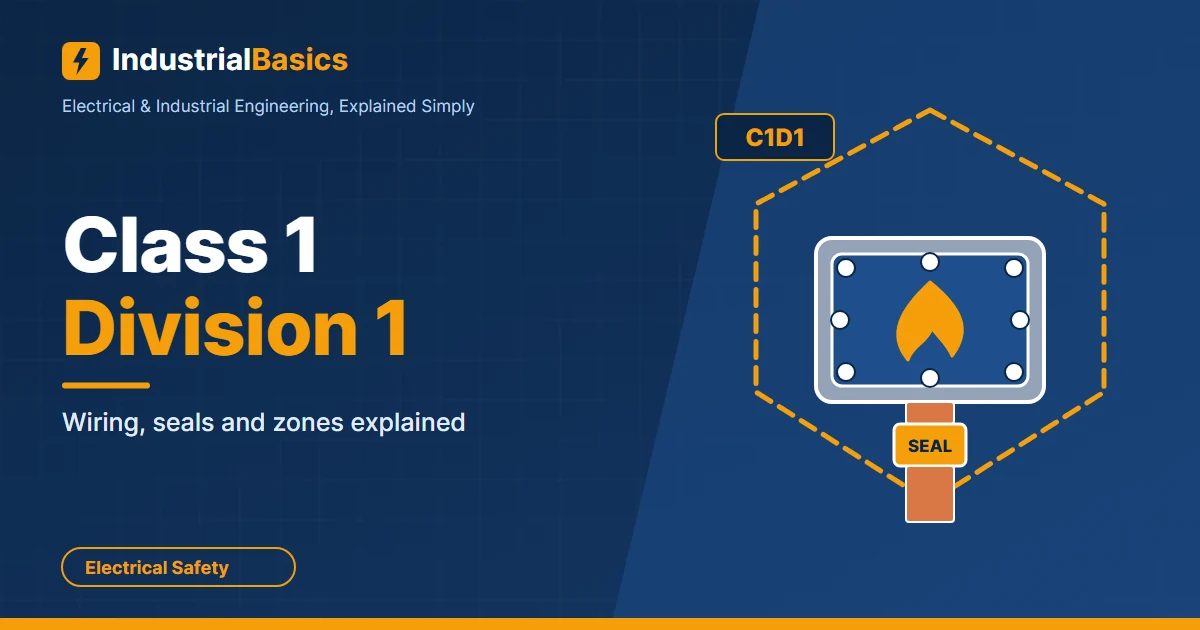
Class 1 Division 1 is a hazardous location where ignitable flammable gases or vapors may be present during normal operation. Electrical equipment there must be approved for the location, conduit must be threaded and wrench-tight, and raceway seals are required at specific points to stop gas and flame from traveling through the system. In the US, the rules come from OSHA 1910.307 and NEC Article 501.
| Requirement | Summary | Reference |
|---|---|---|
| Equipment | Approved for the class, group and temperature | OSHA 1910.307(c) |
| Protection | Explosionproof, purged and pressurized, intrinsically safe or other approved technique | OSHA 1910.307(f) |
| Conduit | Threaded and made wrench-tight | OSHA 1910.307(d) |
| Raceway seals | At specified enclosures and boundaries | NEC 501.15 |
| Marking | Class, group and operating temperature or range | OSHA 1910.307(c)(2) |
| Documentation | Classified areas documented where required | OSHA 1910.307(b) |
What Class 1 Division 1 Means
The name has two parts. Class I means flammable gases or vapors may be present in the air in quantities that could produce explosive or ignitable mixtures. Division 1 describes how likely that is. Under OSHA 1910.399, a location is Class I, Division 1 if any of these applies:
- Ignitable concentrations may exist under normal operating conditions.
- They may exist frequently because of repair, maintenance or leakage.
- A breakdown or faulty operation might release them and could also cause electrical equipment to fail at the same time.
A Division 2 location is less likely to have gas present. Flammable materials are normally confined in closed systems, ignitable concentrations are normally prevented by positive mechanical ventilation, or the area adjoins a Division 1 location.
Divisions vs Zones
OSHA allows a Class I installation to use either the division system or the zone system. The zone system splits the highest-risk conditions more finely:
| Zone | OSHA description | Protection techniques in 1910.307(g) |
|---|---|---|
| Zone 0 | Present continuously or for long periods | Intrinsic safety |
| Zone 1 | Likely in normal operation, or frequent through repair or leakage | Flameproof “d”, purged and pressurized, intrinsic safety, oil “o”, increased safety “e”, encapsulation “m”, powder “q” |
| Zone 2 | Not likely in normal operation, and short-lived if it occurs | Purged and pressurized, type “n”, plus higher-zone equipment for the same gas |
Protection Techniques for Division 1
| Technique | How it works | Practical note |
|---|---|---|
| Explosionproof | The enclosure is built to contain an internal explosion | Damaged joints or missing bolts defeat it |
| Purged and pressurized | Clean air or inert gas keeps flammable gas out | Depends on maintaining the supply |
| Intrinsically safe | Limits energy so a circuit cannot ignite the gas | Common for instruments and 4-20 mA loops |
Every item must be approved for the specific location. A general-purpose sensor, junction box or motor starter cannot simply be placed inside the area. OSHA also requires equipment to be marked with its class, group and operating temperature or range, based on a 40 °C ambient unless otherwise marked.
Wiring and Conduit Requirements
OSHA 1910.307(d) states that all conduits shall be threaded and shall be made wrench-tight. If a threaded joint cannot be made tight, a bonding jumper is required. The tight joint matters because fault current through a loose connection can spark inside the hazardous area.
The permitted wiring methods are listed in NEC Article 501 and can change between editions, so we do not reproduce them here. Check the current text before you select conduit or cable. Bonding also matters, and our guide to earthing and grounding covers the basics.
Raceway Seal Rules
A seal limits the passage of gas and stops an explosion from traveling through the conduit. These points come from EC&M’s explanation of NEC 501.15, which does not name a code edition:
| Situation in Division 1 | Seal rule |
|---|---|
| Raceway enters an explosionproof enclosure with make-and-break contacts | Seal required |
| Size 1/2 to 1-1/2 raceway enters a box with no make-and-break contacts | Not required under this rule |
| Size 2 or larger raceway enters a junction or splice box | Seal within 18 in. of the enclosure |
| Raceway leaves the Division 1 location | Seal within 10 ft of the boundary, with exceptions |
| Sealing compound thickness | At least the trade size of the fitting, and never under 5/8 in. |
| Conductor fill in the seal | Up to 25% of the same size RMC, unless identified for more |
| Splices and taps | Not allowed inside a seal fitting |
Worked example: checking three raceways
| Raceway | Enclosure | Result |
|---|---|---|
| 1 in. | Explosionproof box with a contactor (make-and-break contacts) | Seal required |
| 1 in. | Explosionproof box with terminals only | No enclosure seal under this rule |
| 2 in. | Explosionproof splice box | Seal within 18 in. |
For the compound, a 1 in. fitting needs at least 1 in. of compound. A 1/2 in. fitting still needs 5/8 in., because that is the minimum. Follow the fitting maker’s instructions for dams, mixing and curing.
How to Read Equipment Markings
Zone equipment is marked in a fixed order: class, zone, AEx symbol, protection technique, gas group and temperature class. Confirm that the zone, gas group and temperature class all suit the area. The temperature class must be safe for the specific gas or vapor, which is why the classification documents need to identify it.
Practical Checklist
- Get the area classification drawing and confirm the class, division or zone, and group.
- Check every device’s marking against that classification.
- Confirm the wiring method in your adopted NEC.
- Locate every seal, including boundary seals.
- Make all conduit joints wrench-tight and check bonding.
- Pour and inspect seals to the manufacturer’s instructions.
- Isolate power and verify the atmosphere under your site’s permit system before opening equipment, with lockout/tagout applied.
- Keep enclosure joints clean and all bolts fitted during maintenance.
Classified areas carry risks beyond ignition, so also review electrical hazards in industry and arc flash. UK and European sites generally work to different rules, so this US guide should not be used for them.
Frequently Asked Questions
What is a Class 1 Division 1 location?
It is an area where ignitable concentrations of flammable gases or vapors may exist in normal operation, frequently because of repair, maintenance or leakage, or when a breakdown could release gas and also fault electrical equipment.
What is the difference between Class 1 Division 1 and Division 2?
In Division 1, ignitable gas may exist during normal operation. In Division 2, it is normally confined or prevented by ventilation, or the area is next to a Division 1 location.
Is Division 1 the same as Zone 1?
No. Division 1 broadly covers conditions that the zone system splits into Zone 0 and Zone 1. Do not swap one for the other without an engineered reclassification.
What protection methods are allowed in Class 1 Division 1?
OSHA permits equipment approved for the location, including explosionproof, purged and pressurized, and intrinsically safe equipment.
Can Division 1 equipment be used in Division 2?
Yes. OSHA permits equipment approved for Division 1 in a Division 2 location of the same class and group.
When is a conduit seal required in Division 1?
Commonly where a raceway enters an explosionproof enclosure with make-and-break contacts, where a size 2 or larger raceway enters a box with splices or taps, and where it leaves the Division 1 area.
How far can a seal be from the boundary?
EC&M’s summary of NEC 501.15 gives within 10 ft of the Class I, Division 1 boundary, with exceptions.
Who decides an area’s classification?
Classification should be done by qualified engineers and documented. Under OSHA, zone classification work must be supervised by a qualified registered professional engineer.
Sources and Further Reading
- OSHA: 29 CFR 1910.307, Hazardous (Classified) Locations: protection, marking, conduit and zone rules.
- OSHA: 29 CFR 1910.399, Definitions: division and zone definitions.
- EC&M: Code Installation Requirements for Raceway Seals in Class I Locations (2016): explanation of NEC 501.15.