
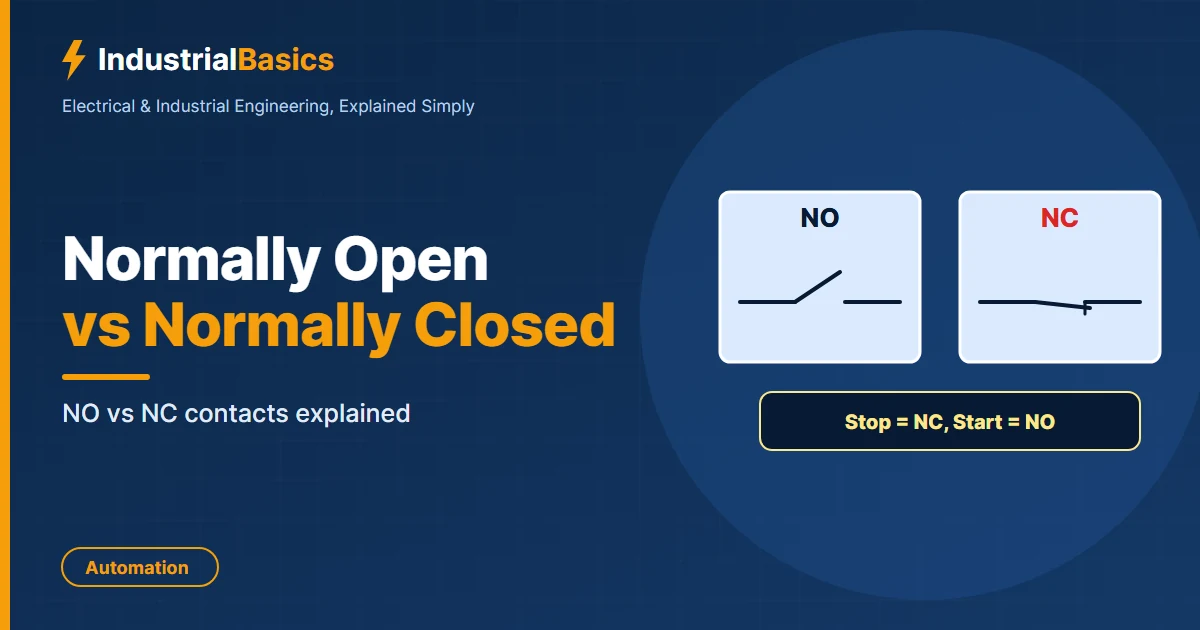
A normally open (NO) contact is open when the device is at rest and closes when it is operated. A normally closed (NC) contact is closed at rest and opens when operated. “Normal” means not actuated: button released, relay coil de-energized, sensor not triggered. Start buttons are usually NO and stop buttons NC, so a broken wire stops the machine. In ladder logic, ─| |─ (XIC) and ─|/|─ (XIO) test the input bit. They are not the same as the field device’s NO or NC wiring, which is the most common source of confusion.
Normally Open vs Normally Closed Symbols
| Normally open (NO) | Normally closed (NC) | |
|---|---|---|
| At rest | Open: no current | Closed: current flows |
| When operated | Closes (“make”) | Opens (“break”) |
| Form / SPST code | Form A, SPST-NO | Form B, SPST-NC |
| Push button name | Push-to-make | Push-to-break |
| Typical use | Start buttons, run commands, many sensors | Stop and e-stop buttons, permissives, alarms that must fail safe |
Wikipedia notes that NO and NC describe contacts that stay in one state unless actuated, like a push-button. A switch with both types is a changeover (double-throw) switch. It can be make-before-break, briefly connecting both circuits, or break-before-make. The forms map to SPST, SPDT and similar codes; for relay contact forms and wet versus dry contacts, see dry contact relay. For pole and throw counts, see SPDT vs DPDT.
NO/NC Devices vs Ladder Logic Instructions
In ladder logic, ─| |─ is a normally open contact, closed (true) when its input or coil is energized. ─|/|─ is a normally closed “not” contact, true when the input is not energized (Wikipedia). These instructions test the input bit. The physical contact in the field is a separate choice. An NC stop button wired to an input reads 1 while healthy, so it is programmed with ─| |─ (XIC). Pressing the button or breaking the wire drops the bit to 0 and stops the rung.
Field Device vs Instruction Helper
Start/Stop Seal-In: Why Stop Buttons Are NC
Wikipedia’s industrial start/stop example uses a momentary NO start button in parallel with a NO “Run” seal-in contact, in series with an NC stop button: Run = (Start OR Run) AND NOT Stop. Pressing start energizes Run, the seal-in holds it, and pressing stop opens the NC contact and drops the circuit. For safety, an emergency stop is hardwired in series as well. Because an NC device holds the circuit closed only while everything is intact, a cut wire or loose terminal behaves like pressing stop. That is the fail-safe reason stop functions use NC contacts. For e-stop requirements, see the e-stop guide.
Choosing NO or NC for Sensors
- Ask what a broken wire should do. If it must stop the process or raise an alarm, use an NC contact so the open circuit reads as the fault state.
- Permissives and guards: use NC, closed when it is safe to run.
- Counting and presence: NO is common because the signal appears only when something is detected.
- Check the datasheet: many sensors offer NO, NC or selectable outputs; PNP or NPN output type is a separate choice from NO or NC.
For PLC wiring and protection, see interposing relays and PLC I/O fuse protection.
Frequently Asked Questions
What does normally open mean?
A normally open (NO) contact is open, passing no current, when the device is at rest, and closes when it is operated, for example a push-to-make button (Wikipedia, Switch).
What does normally closed mean?
A normally closed (NC) contact is closed at rest and opens when the device is operated, for example a push-to-break button.
What is the normal state of a relay?
The state with the coil de-energized. NO contacts are open and NC contacts closed until the coil is energized.
What is Form A and Form B?
Form A is single-pole, single-throw normally open (SPST-NO); Form B is SPST normally closed (SPST-NC). Form C is a changeover with both (Wikipedia).
Why are stop buttons normally closed?
So that the stop function also happens if the wire breaks or a terminal loosens: the NC contact holds the circuit closed while healthy, and any open circuit stops the machine. Wikipedia’s ladder logic article shows stop and e-stop as NC devices in series with the start seal-in.
What is the symbol for a normally open contact?
In ladder logic, ─| |─; normally closed is ─|/|─. In schematics an NO switch is drawn with the blade open and an NC switch with the blade touching the contact.
Is a ladder NC contact the same as an NC switch?
No. In ladder logic, ─|/|─ (XIO) tests whether the input bit is 0. Whether the field device is NO or NC is separate: an NC stop button is usually programmed with ─| |─ (XIC) because its input is 1 when healthy.
What is make-before-break?
A changeover contact that briefly connects both circuits during switching; break-before-make opens one circuit before closing the other (Wikipedia).
Are NO or NC sensors better?
It depends on what should happen on a fault. For safety and permissive signals, choose the state where a broken wire produces the safe outcome; for simple counting or presence detection, NO is common.
How do I test whether a contact is NO or NC?
With power off, measure continuity across the contact at rest: continuity means NC, open means NO. Operate the device and the reading should change.
Sources and Further Reading
- Wikipedia: Switch: NO/NC terminology, contact forms, make-before-break.
- Wikipedia: Ladder logic: contact symbols, start/stop seal-in, e-stop in series.



