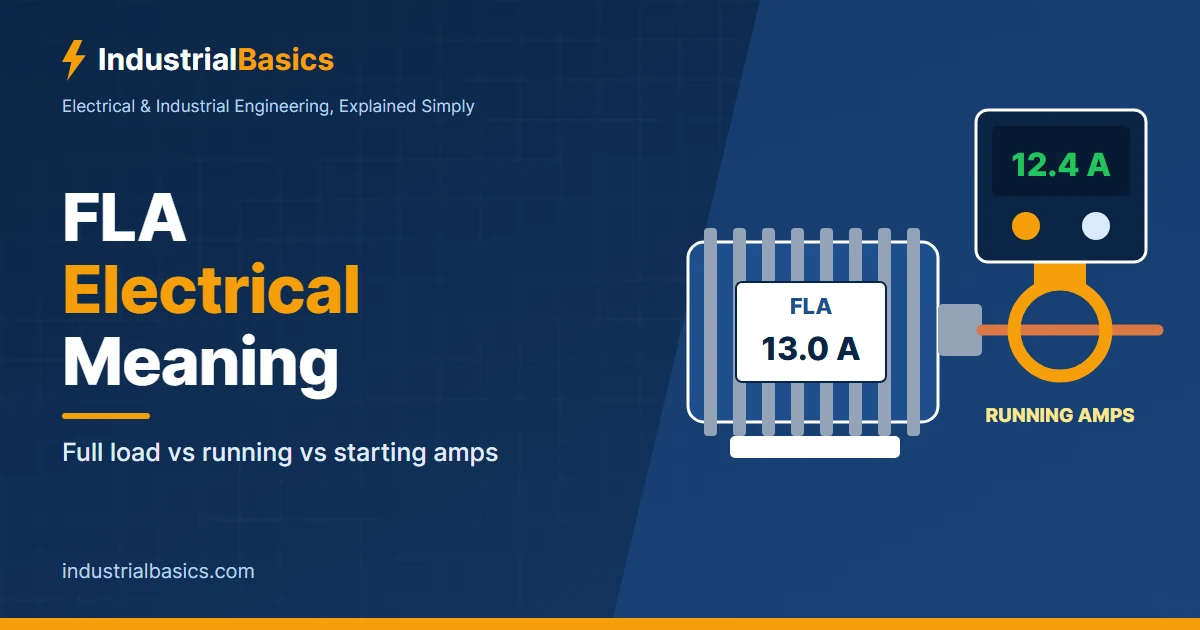
FLA stands for Full Load Amps: the current a motor draws when it delivers its rated horsepower at rated voltage and frequency. You will find it on the motor nameplate. Running amps are what the motor actually draws at its present load, usually less than FLA. Starting amps, or locked rotor amps (LRA), are the much larger current drawn while the motor accelerates, typically around six times running current.
| Term | Meaning | Where it comes from | Used for |
|---|---|---|---|
| FLA | Rated current at full load | Motor nameplate | Overload protection |
| FLC | Standard full-load current | NEC Tables 430.248 and 430.250 | Conductors and short-circuit protection |
| Running amps | Actual current right now | Clamp meter | Checking load and faults |
| LRA | Current with the rotor stopped | Datasheet or code letter | Starting and voltage dip |
| Peak inrush | First half-cycle transient | Measurement or datasheet | Nuisance trip analysis |
| SFA | Current at service factor load | Nameplate, if listed | Understanding overload margin |
What Is Full Load Amps (FLA)?
FLA is a rated value measured by the manufacturer. It tells you how much current the motor is designed to draw when delivering its full rated output under rated conditions. It is not a limit on what the motor will try to draw. If the load increases, the current rises above FLA, and the motor heats up.
How to estimate FLA
When you do not have the nameplate, you can estimate three-phase current from the horsepower, voltage, efficiency and power factor.
For a 10 HP, 460 V motor with an assumed efficiency of 0.90 and power factor of 0.85:
Treat this as an estimate. Actual efficiency and power factor vary by motor, and it is not a substitute for the nameplate or the NEC table.
Running Amps vs FLA vs Starting Amps
A motor passes through all of these currents on a normal start. The first peak lasts only a fraction of a cycle. Current then stays near the locked rotor value until the motor approaches operating speed, and finally falls to a running value set by the load.
The U.S. Department of Energy notes that NEMA recognizes two parts of starting current: instantaneous peak inrush, which occurs within half an AC cycle, and locked rotor current, the RMS current that follows. In everyday speech, “inrush” often means locked rotor current, so check which one a document is describing.
NEC Table FLC vs Nameplate FLA
This is the distinction that matters most in design. NEC 430.6(A)(1) generally requires the table current for sizing conductors and short-circuit protection, even if the nameplate shows a lower figure. That way, the circuit still works if the motor is later replaced. The nameplate FLA is used to set overload protection.
| Three-phase HP | 230 V table FLC | 460 V table FLC |
|---|---|---|
| 1 | 4.2 A | 2.1 A |
| 5 | 15.2 A | 7.6 A |
| 10 | 28 A | 14 A |
| 25 | 68 A | 34 A |
| 50 | 130 A | 65 A |
| 100 | 248 A | 124 A |
Worked Example: 10 HP, 460 V Motor
Take a continuous-duty, three-phase motor with a nameplate FLA of 13 A, service factor 1.15 and code letter G.
| Step | Calculation | Result |
|---|---|---|
| Table FLC | NEC Table 430.250, 10 HP at 460 V | 14 A |
| Conductor ampacity | 14 A × 125% | 17.5 A minimum |
| Overload (SF 1.15) | 13 A × 125% | 16.25 A maximum |
| Locked rotor kVA | 10 HP × 5.6 to 6.29 kVA/HP | 56 to 62.9 kVA |
| Locked rotor amps | kVA × 1000 / (1.732 × 460) | About 70 to 79 A |
Once you know the ampacity you need, use our AWG wire ampacity chart to choose the conductor. A correctly set thermal overload relay then protects the motor, while the breaker or fuse handles short circuits.
NEMA code letters
| Code letter | Locked rotor kVA per HP |
|---|---|
| E | 4.5 to 4.99 |
| F | 5.0 to 5.59 |
| G | 5.6 to 6.29 |
| H | 6.3 to 7.09 |
| J | 7.1 to 7.99 |
| K | 8.0 to 8.99 |
What Running Amps Tell You
Comparing measured current with FLA is one of the quickest motor health checks. Measure all three phases with a true RMS clamp meter while the motor runs under normal load.
| Reading | What it may mean | What to check |
|---|---|---|
| Well below FLA | Light load | Oversized motor or a broken coupling |
| Close to FLA | Normal full-load operation | Temperature and trend over time |
| Above FLA | Overload or supply problem | Mechanical load, bearings and voltage |
| Unequal phase currents | Unbalance or winding fault | Supply voltage and connections |
| Stays high after start | Motor is not reaching speed | Load, voltage drop and starter |
High starting current can cause voltage dips and nuisance trips. A VFD or soft starter reduces it, and our guide to motor starters compares the options. For repeat failures, see motor failure causes.
To compare a motor’s running current with its FLA, you need a correct current reading; our guide on how to check amps with a multimeter covers the series method, jacks, fuses and clamp meters.
To work out what a motor is actually delivering, see how to calculate motor horsepower from amps, torque or pump duty.
Frequently Asked Questions
What does FLA mean in electrical terms?
FLA stands for Full Load Amps. It is the current a motor draws when producing its rated horsepower at rated voltage and frequency, and it is marked on the nameplate.
What is the difference between FLA and FLC?
FLA usually means the nameplate current of the actual motor. FLC often refers to the standard full-load current in the NEC tables. The NEC uses the table value for conductors and short-circuit protection, and the nameplate value for overload protection.
What is the difference between FLA and running amps?
FLA is a rating. Running amps are what the motor actually draws at the moment, which depends on load and voltage. A lightly loaded motor usually draws less than FLA.
What is LRA?
LRA stands for Locked Rotor Amps. It is the steady RMS current a motor draws at rated voltage with its rotor stopped, and the motor stays near this current during acceleration.
How much higher is starting current than FLA?
For across-the-line starting, it is typically around six times running current, and commonly quoted in a range of about 5 to 8 times. Use the code letter or manufacturer data for a real motor.
Is it bad if a motor draws more than FLA?
Sustained current above FLA means the motor is overloaded, or the supply has a problem, unless it is within the service factor allowance. It causes extra heat and shortens insulation life, so find the cause.
Can I size wire from the nameplate FLA?
For most general-purpose motors, no. NEC 430.6(A)(1) requires the table current for conductors and branch circuit protection. There are exceptions, including some multispeed and low-speed motors, so check the code.
What are service factor amps?
Service factor amps are the current at the motor’s service factor load, such as 1.15 times rated power. They describe a limited overload capability and are not a reason to reduce the circuit size.
Sources and Further Reading
- U.S. Department of Energy: Avoid Nuisance Tripping: peak inrush, locked rotor current and code letters.
- EC&M: Motors and the NEC: table current, nameplate current and overload limits.
- Engineering ToolBox: Locked Rotor Code Letters: kVA per horsepower bands.
- Reuven Tools: Motor Full-Load Current Chart: NEC Table 430.248 and 430.250 values.
- JourneymanIQ: NEC Table 430.250: how table current is applied.
- Electric Calculators: How to Read a Motor Nameplate: FLA, service factor and LRA.