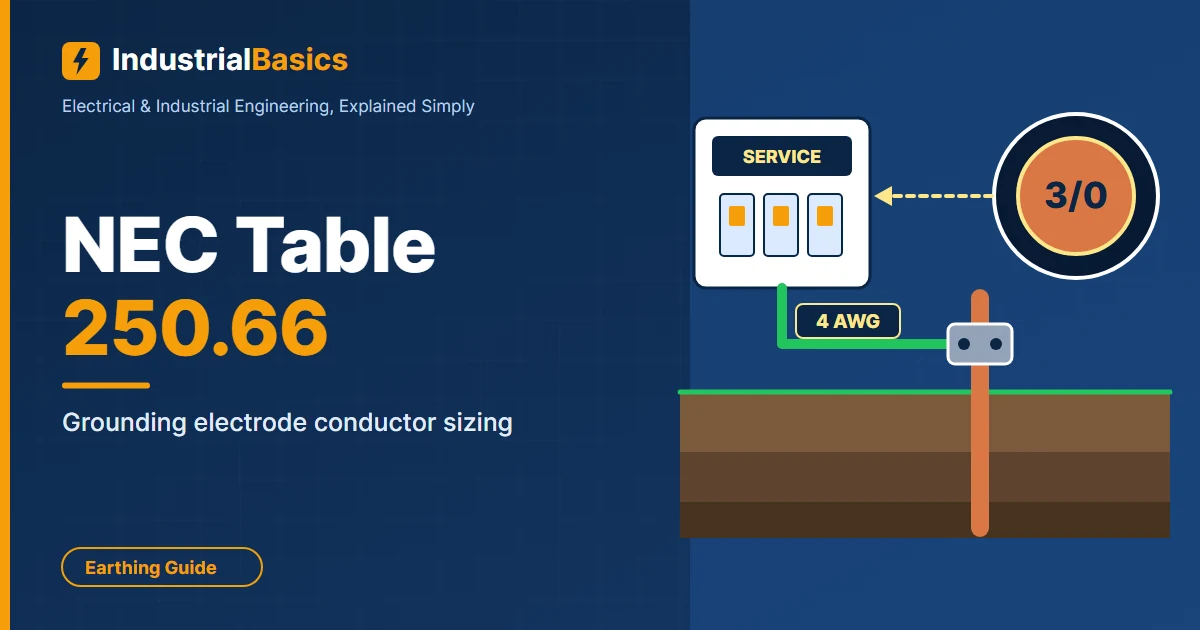
NEC Table 250.66 sizes the grounding electrode conductor (GEC) for AC systems from the largest ungrounded conductor, or the equivalent area of parallel conductors. Find your conductor size in the left columns and read the GEC size on the right. For example, 3/0 AWG copper service conductors require a 4 AWG copper or 2 AWG aluminum GEC. Smaller limits can apply to the part of the conductor that goes only to a rod, concrete-encased electrode or ground ring.
| Largest ungrounded: copper (AWG/kcmil) | Largest ungrounded: Al or CCA (AWG/kcmil) | GEC: copper | GEC: Al or CCA |
|---|---|---|---|
| 2 or smaller | 1/0 or smaller | 8 AWG | 6 AWG |
| 1 or 1/0 | 2/0 or 3/0 | 6 AWG | 4 AWG |
| 2/0 or 3/0 | 4/0 or 250 | 4 AWG | 2 AWG |
| Over 3/0 through 350 | Over 250 through 500 | 2 AWG | 1/0 AWG |
| Over 350 through 600 | Over 500 through 900 | 1/0 AWG | 3/0 AWG |
| Over 600 through 1100 | Over 900 through 1750 | 2/0 AWG | 4/0 AWG |
| Over 1100 | Over 1750 | 3/0 AWG | 250 kcmil |
GEC Size Calculator
Choose the conductor material, the largest ungrounded conductor and the number of parallel sets. The calculator adds the parallel area and reads the matching row of Table 250.66.
How to Read Table 250.66
- Identify the largest ungrounded conductor supplying the system.
- If conductors are in parallel, add the areas of the corresponding conductors in each set.
- Use the column for the ungrounded conductor material.
- Read across to the GEC column for the GEC material you will install.
- Check whether 250.66(A), (B) or (C) allows a smaller conductor for the electrode connection.
The GEC is not sized from the breaker rating. That is a common mix-up with the equipment grounding conductor chart, which uses the overcurrent device rating. If the terms are unfamiliar, our guide to earthing vs grounding explains the difference.
Smaller Limits for Specific Electrodes
Table 250.66 is the general rule, but three electrode types have their own limit. Each limit applies only when the conductor does not extend on to another electrode type that requires a larger conductor.
| Section | Electrode | Conductor not required to be larger than |
|---|---|---|
| 250.66(A) | Rod, pipe or plate | 6 AWG copper or 4 AWG aluminum |
| 250.66(B) | Concrete-encased | 4 AWG copper |
| 250.66(C) | Ground ring | The conductor used for the ground ring |
Routing matters. If a GEC runs from the service to a ground rod first and then continues to a water pipe, the section to the rod must be sized from Table 250.66 as if it ran directly to the water pipe. The 6 AWG limit no longer applies because the conductor extends to an electrode that needs a larger size. Bonding jumpers between electrodes are sized through 250.53(C), which refers back to 250.66.
Worked Examples
Example 1: Single 3/0 copper service
The largest ungrounded conductor is 3/0 AWG copper, which falls in the 2/0 or 3/0 row. The GEC is 4 AWG copper or 2 AWG aluminum. A jumper that serves only a ground rod is not required to be larger than 6 AWG copper.
Example 2: Parallel 500 kcmil copper
An 800 A, three-phase service uses two 500 kcmil copper conductors per phase.
1000 kcmil falls in the Over 600 through 1100 row, so the GEC is 2/0 AWG copper.
Example 3: Parallel aluminum
Four 250 kcmil aluminum conductors per phase equal 1000 kcmil aluminum. That is in the Over 900 through 1750 row, so the GEC is 2/0 AWG copper or 4/0 AWG aluminum.
| Service conductors | Equivalent area | Table row | GEC |
|---|---|---|---|
| 3/0 AWG Cu | 3/0 AWG | 2/0 or 3/0 | 4 AWG Cu or 2 AWG Al |
| 750 kcmil Al | 750 kcmil | Over 500 through 900 | 1/0 AWG Cu or 3/0 AWG Al |
| 2 × 500 kcmil Cu | 1000 kcmil | Over 600 through 1100 | 2/0 AWG Cu or 4/0 AWG Al |
| 4 × 250 kcmil Al | 1000 kcmil | Over 900 through 1750 | 2/0 AWG Cu or 4/0 AWG Al |
Table 250.66 vs Other Article 250 Tables
| Table | Sizes | Based on |
|---|---|---|
| 250.66 | Grounding electrode conductor | Largest ungrounded conductor or equivalent area |
| 250.102(C)(1) | Grounded conductor, main, system and supply-side bonding jumpers | Largest ungrounded conductor or equivalent area |
| 250.122 | Equipment grounding conductor | Overcurrent device rating |
The tables look similar but are not interchangeable. NFPA specifically warns that Table 250.102(C)(1) is not for sizing grounding electrode conductors. For the wider system context, see our guide to types of earthing systems. Phase conductor capacity is covered separately in our AWG wire ampacity chart.
Common Sizing Mistakes
| Mistake | Why it is wrong | Correct approach |
|---|---|---|
| Sizing from the breaker | Table 250.66 uses conductor size | Use the largest ungrounded conductor |
| Ignoring parallel sets | The table uses equivalent area | Add the corresponding conductors |
| Using 6 AWG to every electrode | The limit applies only to certain connections | Check where the conductor continues |
| Reading the wrong material column | Copper and aluminum rows differ | Match both conductor materials |
| Using Table 250.102(C)(1) | It sizes bonding jumpers and grounded conductors | Use Table 250.66 for the GEC |
If your service uses parallel sets or has no service-entrance conductors, see our focused guide to Table 250.66 Note 1 and Note 2.
Table 250.66 is one of three sizing tables in the grounding article; our NEC Article 250 guide maps which table sizes each grounding and bonding conductor.
Frequently Asked Questions
What is NEC Table 250.66 used for?
It sizes the grounding electrode conductor for AC systems at a service, at a building supplied by a feeder or branch circuit, and at a separately derived system.
What size GEC is required for 3/0 copper service conductors?
Table 250.66 requires 4 AWG copper or 2 AWG aluminum or copper-clad aluminum. A connection only to a rod, pipe or plate electrode may be limited to 6 AWG copper or 4 AWG aluminum.
Is a 6 AWG copper GEC enough for a ground rod?
Yes, when that conductor connects to a rod, pipe or plate electrode and does not extend on to another electrode type that requires a larger conductor.
What size GEC goes to a concrete-encased electrode?
It is not required to be larger than 4 AWG copper, provided the conductor does not extend on to another electrode type that requires a larger size.
How do you size a GEC for parallel conductors?
Add the areas of the corresponding conductors in each set, then use that total in the table. Two 500 kcmil copper conductors per phase equal 1000 kcmil, which requires a 2/0 AWG copper GEC.
What is the largest GEC required by Table 250.66?
The largest size in the table is 3/0 AWG copper or 250 kcmil aluminum or copper-clad aluminum. It applies above 1100 kcmil copper or 1750 kcmil aluminum.
What is the difference between Table 250.66 and Table 250.122?
Table 250.66 sizes the grounding electrode conductor from the largest ungrounded conductor. Table 250.122 sizes the equipment grounding conductor from the overcurrent device rating.
Can I install a GEC larger than the table requires?
Yes. NFPA notes that using bonding jumpers or grounding electrode conductors larger than those required by 250.66 is not prohibited.
Sources and Further Reading
- NFPA fact sheet, Grounding and Bonding: Using the Tables in Article 250 of the NEC: Table 250.66, notes, electrode limits and parallel example.
- IAEI: Sizing of Conductors Related to Grounding and Bonding: worked examples and table comparison.
- EC&M: Code Q&A, Sizing the GEC: electrode conductor limits.
- Open Exam Prep: Grounding Electrode Conductor Sizing: independent check of the copper rows.