
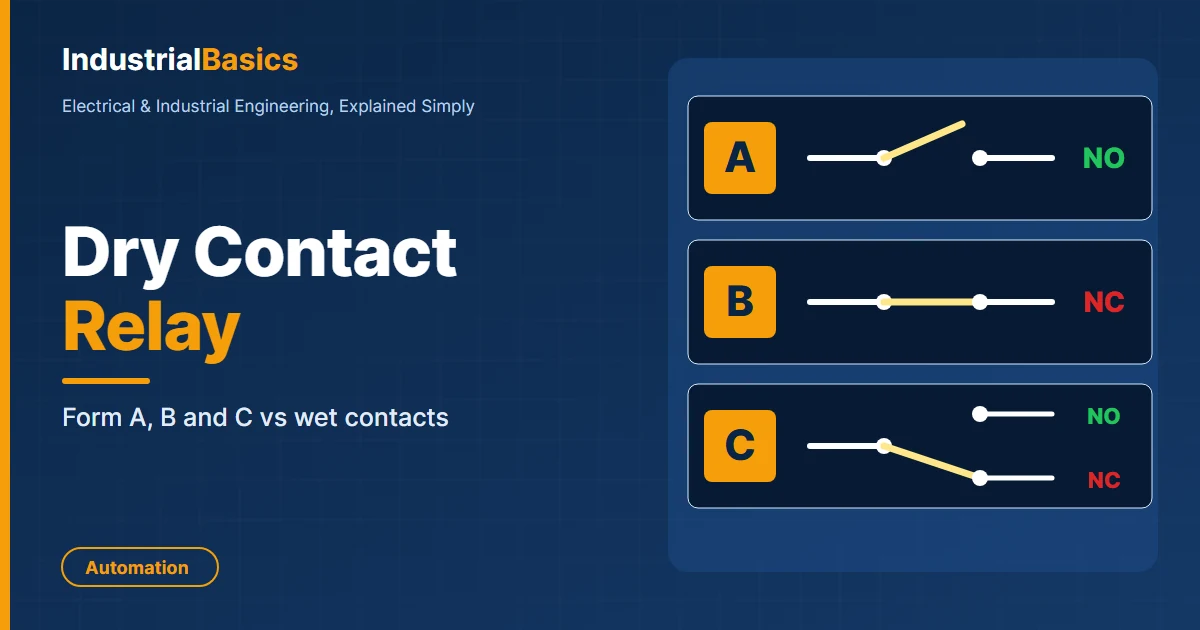
A dry contact relay provides a voltage-free switch: it opens or closes a path, while the device reading it supplies the voltage. A wet contact already carries voltage from its own device. Form A, B and C describe something different: normally open, normally closed and changeover contacts. Any of these forms can be dry or wet, depending on how the relay is wired.
| Term | Meaning | Also called |
|---|---|---|
| Dry contact | No voltage from the device with the contact | Volt-free, potential-free |
| Wet contact | Carries voltage from its own device | Powered contact |
| Form A | Normally open | SPST-NO, make |
| Form B | Normally closed | SPST-NC, break |
| Form C | Common switches between NC and NO | SPDT, changeover |
Dry vs Wet Contacts
The difference is where the voltage comes from. With a dry contact, the reading device, such as a PLC input, supplies the voltage and senses whether the path is closed. With a wet contact, the field device provides the voltage.
| Factor | Dry contact | Wet contact |
|---|---|---|
| Voltage source | The connected circuit | The device with the contact |
| Input type needed | Input that supplies wetting voltage, or an external supply | Input that senses voltage |
| Main wiring risk | No signal if no supply is provided | Voltage connected to the wrong input |
| Flexibility | Can switch a separate circuit within its rating | Tied to the device’s supply |
Form A, B and C Contacts
Contact drawings show the relay de-energized. Form C is the most flexible because it offers both a normally open and a normally closed path from one common terminal.
| Form | USA | EU | EN 50005 terminals |
|---|---|---|---|
| A | SPST-NO | NO | 11 (common), 14 (NO) |
| B | SPST-NC | NC | 11 (common), 12 (NC) |
| C | SPDT | CO | 11 (common), 12 (NC), 14 (NO) |
The coil terminals are normally marked A1 and A2. For a fail-safe alarm, a relay is often kept energized while healthy, so a power loss also causes an alarm. To see how relays fit into a control panel, read our comparison of contactors and relays.
Wetting Current and Minimum Load
Relay contacts can develop a thin film of oxide or contamination. A contact needs a certain minimum voltage and current to break through it. If the signal is too small, a closed contact may read as open or become intermittent. This is why a big power relay can be unreliable on a tiny PLC input.
| Contact material | TE recommended minimum load |
|---|---|
| Gold or gold plated | 1 mA at 6 V DC |
| AgNi | 10 mA at 12 V DC |
| AgCdO or AgSnO2 | 100 mA at 12 V DC |
Finder suggests no less than 50 mW, 5 V / 2 mA for gold contact variants. These figures differ by manufacturer and product, so always use the datasheet for your relay.
Worked example: relay on a PLC input
Finder explains that a minimum of 300 mW, 5 V / 5 mA means all three values must be met. A 24 V input drawing 5 mA is only:
The voltage and current pass, but 120 mW is below 300 mW, so this relay is not suitable. At 24 V it would need at least 12.5 mA. A gold-contact relay with a 50 mW, 5 V / 2 mA minimum would be suitable for the same input.
Wiring Mistakes to Avoid
| Mistake | Result | Fix |
|---|---|---|
| Connecting voltage to a dry-contact input | Input damage | Check the input type first |
| Expecting voltage from a dry contact | No signal | Provide a supply through the contact |
| Using a power relay for a tiny signal | Intermittent reading | Use a suitable low-level contact |
| Using NO and NC backwards | Inverted logic | Check the de-energized state |
| Switching a coil with no suppression | Contact wear and noise | Add suitable suppression |
If the relay is driven from a PLC output, see our guide to the interposing relay. For input planning, see how to select a PLC. If you need logic as well as switching, compare programmable relays.
For NO vs NC symbols, ladder logic and why stop buttons are normally closed, see normally open vs normally closed.
Frequently Asked Questions
What is a dry contact relay?
It is a relay output with voltage-free contacts. The relay only opens or closes the path, and the connected circuit supplies the voltage.
What is the difference between dry and wet contacts?
A dry contact has no voltage of its own. A wet contact already carries voltage from the device that owns it.
What is a Form C relay contact?
Form C is SPDT changeover. A common terminal connects to the normally closed terminal when de-energized and to the normally open terminal when energized.
What is the difference between Form A and Form B?
Form A is normally open and closes when energized. Form B is normally closed and opens when energized.
What is wetting current?
It is the minimum current a contact needs to switch reliably by breaking through surface oxide or contamination.
Why does a closed relay contact read open?
At very low current, a contaminated contact may not conduct reliably. Check the relay’s minimum load and consider a gold-contact type for signal circuits.
Can I connect 24 V to a dry contact input?
Usually not. An input designed for a dry contact often supplies its own wetting voltage, so adding external voltage can damage it. Check the manual.
Should I use gold contacts for PLC inputs?
For low-level signals, gold contacts are often a better fit because their minimum load is lower. Confirm the value in the datasheet.
Sources and Further Reading
- Finder: General Technical Information: contact forms, terminal marking and minimum switching load.
- TE Connectivity: Industrial Relays Quick Reference Guide: minimum load by contact material.
- Things Embedded: Dry Contact vs Wet Contact: definitions and wetting current.
- AutomationForum: Dry Contact and Wet Contact: terminology and applications.



