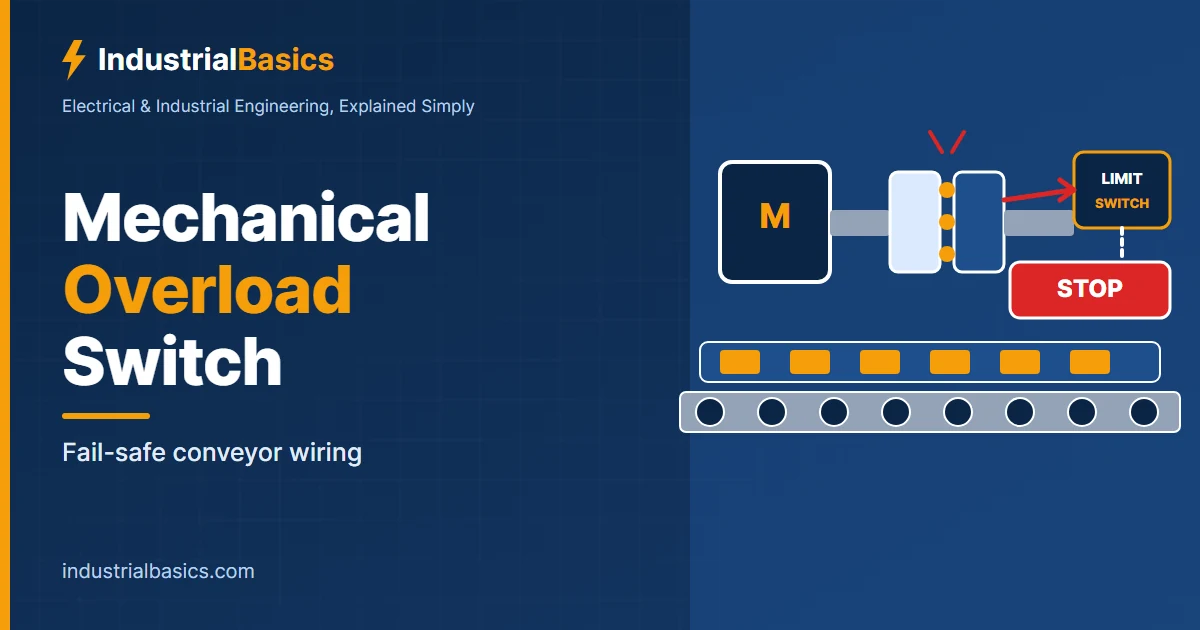
A conveyor mechanical overload switch is a limit switch or proximity sensor that detects when a torque limiter, shear pin hub or overload clutch trips, and tells the controls to stop the motor. Wire it fail-safe: a normally closed, positive-opening contact in series with the motor’s run circuit, so a trip, a cut wire or a lost connection all stop the drive. A normally open contact that only signals an alarm is non-fail-safe, because a broken wire hides the trip and the motor keeps driving the jam.
| Point | Fail-safe arrangement | Non-fail-safe arrangement |
|---|---|---|
| Contact used | Normally closed, opens on trip | Normally open, closes on trip |
| Wired into | Motor run or stop circuit | PLC alarm input only |
| Broken wire | Stops the drive | Goes unnoticed |
| Welded contact | Positive opening forces it apart | Not addressed |
| Best for | Stopping the drive on every trip | Indication where another device stops the drive |
What the Overload Switch Detects
Mechanical overload devices sit in the drive train between the motor and the conveyor. Machine Design describes the main types: shear pins that break at a set load, friction slip clutches, ball or roller detent units, torque-sensing units and free-wheeling units. In most of them, an overload makes the two halves move apart axially.
That movement is what the switch detects. R+W’s SLN manual says that when the actuation ring moves axially, “the mechanical limit switch or proximity sensor is activated, signaling the drive to be shut down”. Machine Design adds that the switch “turns off the machine or alerts an operator”. Tsubaki notes that when a conveyor jams, the limiter automatically disconnects the driving motor from the driven components. Without the switch, the motor would keep running against a slipping or disengaged limiter.
| Device type | On overload | Reset |
|---|---|---|
| Shear pin | Pin breaks | Replace the pin |
| Friction slip | Linings slip | Automatic when the load drops |
| Ball detent | Balls leave detents and re-seat in the next | Random automatic |
| Roller detent | Rollers leave detents | After a full turn, or at set positions |
| Torque sensing | Halves move, but balls stay engaged | Keeps transmitting torque |
| Free wheeling | Halves separate fully | Manual reset |
Fail-Safe vs Non-Fail-Safe Wiring
“Fail-safe” here means that the likely failures of the switch circuit push the drive toward stopping. A normally closed contact wired in series with the run permissive does this: a trip opens it, a broken wire opens the circuit, and a lost supply drops it. The motor stops in every case.
The reverse arrangement, a normally open contact that closes on trip and feeds an alarm input, is non-fail-safe. If the wire is cut or the terminal works loose, the controls never see the trip. On a conveyor that means the drive can keep turning a disengaged limiter or a jammed chain until something else fails. For relays that pass the signal on, see our dry contact relay guide.
Positive opening contacts
A normally closed contact can still fail closed if it welds. Safety limit switches solve this with positive opening. Honeywell’s catalogue explains that positive opening ensures welded NC contacts “can be forced apart by normal operation of the switch”, guaranteeing an open circuit even after an electrical fault. Such switches are marked with the positive opening symbol.
Honeywell lists two elements of positive opening: no flexible members in the drive train (so wobble-stick actuators cannot be used), and a basic switch mechanism that guarantees the NC circuit opens. Its tests include passing 1,000 A at 110% of rated voltage until a series fuse blows, then confirming contact separation with a 2.5 kV dielectric test.
Inclined Conveyors: When “Fail-Safe” Means the Opposite
On a horizontal conveyor, the limiter letting go is the safe outcome. On an incline it may not be: a fully disengaged drive can let the load run back. Machine Design describes torque-sensing limiters for this case. Their halves move apart enough to trip a limit or proximity switch, but the balls do not leave their detents, so the unit keeps transmitting torque and acts as a fail-safe device “to prevent a load from falling”. It names cranes and inclined conveyors as typical uses.
Electronic Overload Detection
A current-sensing relay is an alternative or a backup. Tsubaki’s Shock Relay is set to the motor’s load current and a permitted surge time, with a start-time setting so it ignores starting current. Tsubaki says it accepts single and three-phase motors up to 600 V, and that thermal relays and inverters do not protect mechanical components because “their purpose is different”.
A thermal overload protects the motor windings from sustained overcurrent, as explained in our thermal overload relay guide. It is too slow to save a chain or gearbox from a sudden jam. Mechanical limiters and current-sensing shock relays react far faster. For PLC-based conveyors, the trip signal can feed the interlock logic covered in our PLC interlock sequence guide.
Worked Example: Screw Conveyor Jam
| Item | Choice and reason |
|---|---|
| Limiter | Ball-detent torque limiter set just above normal running torque |
| Switch | Safety limit switch with a positive-opening NC contact |
| Wiring | NC contact in series with the starter’s stop circuit, plus an auxiliary contact to the PLC for the alarm |
| Reset | Latched trip; operator clears the jam, then resets. R+W limiters re-engage only at slow speed |
| Backup | Current-sensing relay on the motor feeder as a second layer |
Commissioning Checks
- Lock out the drive before setting the switch. Follow your lockout/tagout procedure.
- Set the switch so it actuates within the limiter’s tripped travel but not during normal running.
- Test a trip by moving the limiter to its tripped position by hand and checking that the drive cannot run.
- Cut the wire (simulate by lifting a terminal) and confirm the drive stops or will not start.
- Check the reset so the conveyor does not restart by itself when the switch returns.
For the starter the switch controls, see types of motor starters and our FVNR starter guide.
Frequently Asked Questions
What is a mechanical overload switch on a conveyor?
It is a limit switch or proximity sensor that detects when a torque limiter or overload clutch trips. The R+W SLN manual describes the coupling’s axial movement activating the switch, signalling the drive to shut down.
What is the difference between a fail-safe and non-fail-safe limit switch?
A fail-safe arrangement uses a normally closed contact that opens on a trip, so a trip, a broken wire or lost power all stop the drive. A non-fail-safe arrangement uses a contact that closes on a trip, so a broken wire hides it.
What is positive opening on a limit switch?
Honeywell explains it ensures that if the NC contacts weld, they are forced apart by normal operation of the switch, so an open circuit is guaranteed. Such switches carry the positive opening symbol.
Does a torque limiter stop the motor by itself?
No. It disconnects or slips the drive, but the motor keeps running unless a switch or sensor tells the controls to stop it.
Which torque limiter suits an inclined conveyor?
Machine Design notes that torque-sensing units do not disengage, so they keep transmitting torque, which helps where it is unsafe for the limiter to let go, such as cranes or inclined conveyors.
Is an electronic overload relay a replacement for a mechanical switch?
It can be. Tsubaki’s Shock Relay watches motor current against a set level, with a start-time setting to ignore inrush. Tsubaki says thermal relays and inverters do not protect mechanical components.
How does a torque limiter reset?
It depends on the type. Ball-detent units can reset automatically, roller types may need a full revolution, and free-wheeling units need a manual reset. R+W says its units can only re-engage at slow speed.
Is a conveyor overload switch a safety device?
Usually it protects the machine, not people. Guarding and personnel protection need devices chosen from a risk assessment, with a qualified review.
Sources and Further Reading
- R+W: SLN Series Torque Limiter Installation and Operating Instructions: switch actuation and re-engagement.
- Machine Design: Torque Limiters Tame Overloads: limiter types and torque-sensing units.
- Tsubaki: Overload Protection and Safety Devices catalogue: Shock Relay.
- U.S. Tsubaki: Torque Limiters Ensure Uninterrupted Conveyor Operations: conveyor jams.
- Honeywell: Industrial Safety Products, Standards and Positive Opening Operation: positive opening of NC contacts.