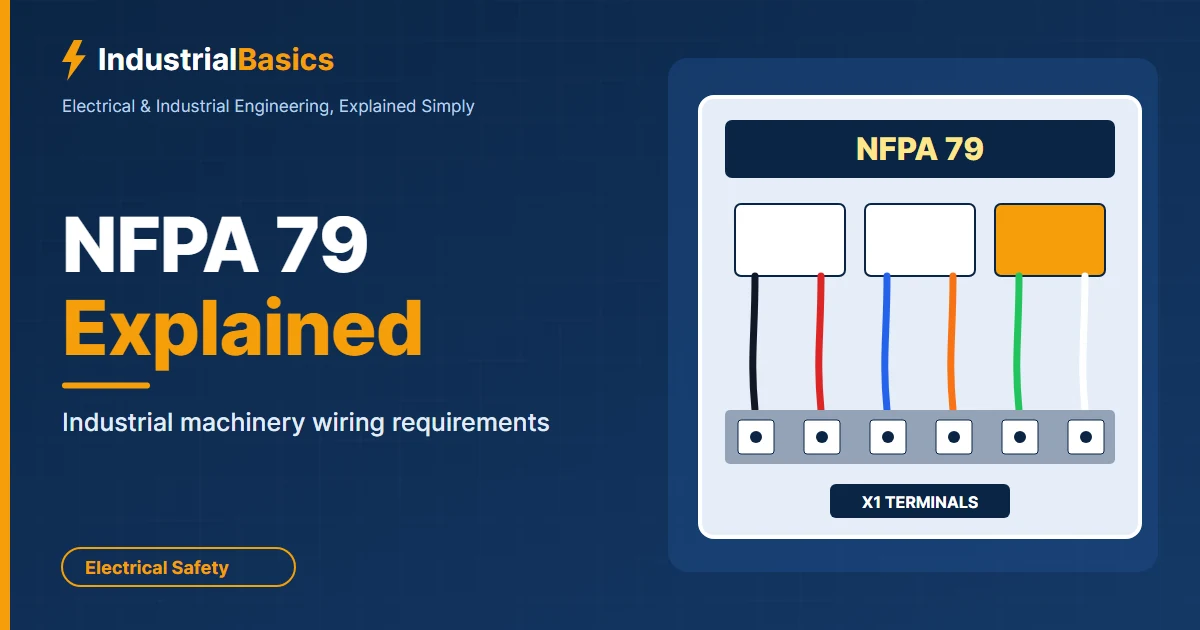
NFPA 79 is the US electrical standard for industrial machinery. It covers the wiring, control circuits, protection, operator controls and documentation of a machine, beginning at the point where the supply connects to it. The NEC handles the building wiring up to that point. If you build, modify, buy or inspect machines for the US market, NFPA 79 is usually the standard the electrical design is judged against.
| Question | Short answer |
|---|---|
| Full name | NFPA 79, Electrical Standard for Industrial Machinery |
| Latest edition | 2024, replacing 2021 |
| Voltage scope | Up to 1000 V AC or 1500 V DC, as described by Intertek |
| Starts at | The machine supply circuit terminals |
| Wire nuts | Not permitted at motor terminal boxes |
| Related code | NEC (NFPA 70), including Article 670 |
What Does NFPA 79 Cover?
NFPA 79 applies to the electrical and electronic equipment that makes an industrial machine work. Typical examples include machine tools, packaging lines, conveyors, presses, robots and assembly equipment. In practice, it shapes decisions such as how the panel is laid out, how wires are identified, how the machine is isolated and how it stops.
| Area | What it affects in practice |
|---|---|
| Supply and disconnect | How the machine is connected, marked and isolated |
| Protection | Overcurrent, motor and shock protection |
| Control circuits | Control voltage, start functions and stop functions |
| Operator interface | Pushbuttons, indicators and emergency stops |
| Control equipment | Enclosures, access and component mounting |
| Conductors and wiring | Wire type, color, identification and terminations |
| Documentation | Diagrams, markings and information supplied with the machine |
NFPA 79 vs NEC: What Is the Difference?
The easiest way to separate them is by location. The NEC governs the premises wiring that brings power to the machine. NFPA 79 governs the electrical equipment on the machine. NEC Article 670 is the bridge between them for industrial machinery, and NEC requirements still apply to how the machine is installed on site.
| Point | NEC (NFPA 70) | NFPA 79 |
|---|---|---|
| Main focus | Building and premises wiring | Industrial machine electrical equipment |
| Typical user | Electrical contractor, inspector | Machine builder, controls engineer |
| Boundary | Up to the machine connection | From the machine supply terminals |
| Example | Feeder to a machine | Wiring inside the machine control panel |
If you are sizing the circuit that feeds a machine, our guide to wire size for a 50 amp circuit shows how NEC ampacity, terminal ratings and derating work.
Are Wire Nuts Allowed Under NFPA 79?
Not at motor terminal boxes. NFPA 79 section 13.5.9.2, as quoted by practitioners, says connections at motor terminal boxes must use an identified method and that twist-on wire connections shall not be used for this purpose. Older editions carried the same idea under a different clause number.
The wider rule is just as important. Machine conductors are generally expected to run from terminal to terminal without splices. Long-standing guidance allows exceptions such as splices in leads attached to equipment like motors and solenoids. Because exceptions differ by edition, check the exact wording before relying on one.
| Connection | Good practice under NFPA 79 |
|---|---|
| Motor terminal box | Use an identified connection method, never twist-on connectors |
| Panel wiring | Land conductors on terminals or device connections |
| Field devices | Use terminal blocks or suitable connectors |
| Device leads | Check whether the splice exception applies |
| Stranded wire | Use terminals or ferrules suited to the conductor |
NFPA 79 Wire Color Code
Consistent colors help a technician understand a panel quickly and avoid touching a circuit that is still live. These are the colors most commonly applied.
Pay special attention to orange. It generally marks excepted circuits that can stay energized when the main disconnect is off, such as an interlock fed from another source. NFPA committee records for clause 13.2.4 state that both the orange color and a safety sign are required for those circuits. Older machines may use yellow for the same purpose, so never rely on color alone. Prove the circuit dead with a meter and follow your lockout/tagout procedure.
Wire identification
Color tells you the circuit type, but it does not identify the individual wire. Conductors should be identified at each termination so the marking matches the machine diagrams. Good wire numbering is one of the cheapest ways to cut troubleshooting time for the life of the machine.
Disconnects, Enclosures and Other 2024 Changes
Intertek’s review of the 2024 edition highlights several changes that affect machine builders.
| Clause | Topic | What changed |
|---|---|---|
| 4.10 | Cybersecurity | New provisions for network-connected machinery, written as a permissive rule |
| 5.1.9.2 | Disconnect marking | Marking wording is now more prescriptive |
| 5.1.9.3 | Multiple supplies | Each disconnect must show the location of the others |
| 5.1.10 | Disconnect types | Acceptable list expanded and clarified |
| 6.2.3.1 | Enclosure access | Verification now refers to a 12.5 mm (1/2 in.) jointed test finger |
| 6.2.3.1.1 | Door-mounted live parts | New protection against inadvertent contact |
If your machine connects to a plant network, the new cybersecurity clause is worth reading alongside your PLC and SCADA architecture. Although it is permissive, it signals what customers are increasingly likely to ask for.
NFPA 79 Stop Categories Explained
NFPA 79 uses three stop categories. Choosing the right one depends on the machine’s risk assessment and on what happens as it comes to rest.
| Category | How it stops | Typical use |
|---|---|---|
| 0 | Immediate removal of power | Simple machines that stop safely when power is removed |
| 1 | Controlled stop, then power removed | Drives and high-inertia machines |
| 2 | Controlled stop with power maintained | Normal operational stops |
On motor-driven machines, the stop function often involves contactors, motor starters or a variable frequency drive. A drive stop needs particular care, because a normal stop command on its own is not the same as a safety function.
NFPA 79 Compliance Checklist
- Confirm the edition named by the customer, contract or authority having jurisdiction.
- Define the boundary between site wiring and machine wiring.
- Check the disconnect type, marking, location and lockability.
- Document the short-circuit rating of the machine and panel.
- Review the risk assessment and select the correct stop categories.
- Check wire colors and numbers against the diagrams.
- Inspect terminations, especially motor boxes and field wiring.
- Mark circuits that stay live with the disconnect off.
- Test the machine before handover, including stop functions and grounding continuity.
- Hand over the documents, including diagrams and maintenance information.
Working on UK or European machinery? The rules are different, so start with our explainer on BS 7671 for installation wiring and confirm which machinery standards apply to your project.
For emergency stop devices, stop categories and reset rules in detail, see our guide to the e-stop.
Frequently Asked Questions
What is NFPA 79?
NFPA 79 is the Electrical Standard for Industrial Machinery. It covers the electrical and electronic equipment of industrial machines, starting at the machine supply terminals.
What is the current edition of NFPA 79?
The 2024 edition replaced the 2021 edition. Check which edition your customer, inspector or jurisdiction requires, because it may not be the latest one.
What voltage does NFPA 79 cover?
Intertek describes the 2024 edition as applying to machinery operating at up to 1000 V AC or 1500 V DC.
Are wire nuts allowed under NFPA 79?
Twist-on connectors must not be used for electrical connections at motor terminal boxes. Elsewhere, machine wiring should generally run terminal to terminal, so confirm any splice against the edition you are using.
What is the difference between NFPA 79 and the NEC?
The NEC mainly governs building installations. NFPA 79 governs the electrical equipment of the machine. NEC Article 670 links the two for industrial machinery.
What color is DC control wire in NFPA 79?
Blue is the usual color for ungrounded DC control conductors. Check the exceptions, including circuits that stay live with the disconnect off.
Why is orange wire used in a control panel?
Orange commonly identifies excepted circuits that can remain energized when the machine disconnect is off. NFPA committee records also tie this to a required safety sign.
Is NFPA 79 a legal requirement?
That depends on the jurisdiction, contract and inspection authority. A customer contract or inspector can also make it a requirement for a specific machine.
Sources and Further Reading
- NFPA 79, Electrical Standard for Industrial Machinery: the official standard page.
- Intertek: NFPA 79 2024 Update, Part 1: scope and cybersecurity.
- Intertek: NFPA 79 2024 Update, Part 2: disconnecting means.
- Intertek: NFPA 79 2024 Update, Part 3: enclosure protection.
- NFPA 79 Technical Committee First Revision Statements: the orange color and safety sign change.
- EC&M: Wiring Methods for Industrial Machinery: background on terminations and identification.