
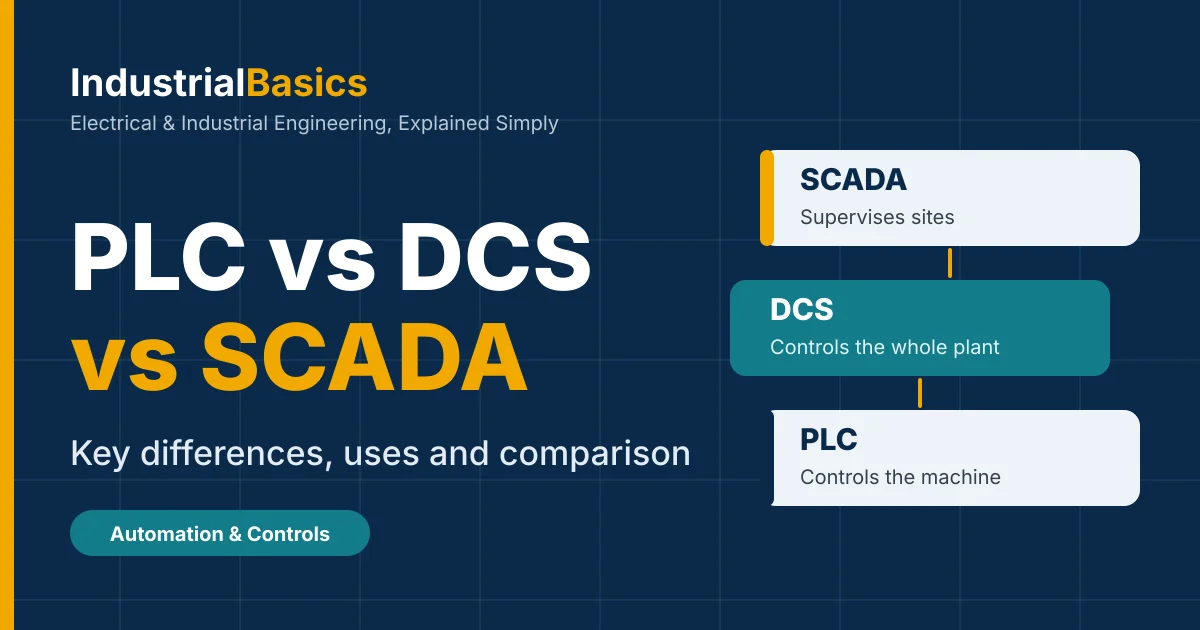
PLC, DCS and SCADA are not three rival products. They work at different layers of an industrial control system. A PLC (Programmable Logic Controller) is a controller that runs logic on a machine or process area. A DCS (Distributed Control System) is a complete plant-wide control system made of many controllers, one engineering environment and operator stations. SCADA (Supervisory Control and Data Acquisition) is a supervisory layer that collects data from PLCs and RTUs, shows it to operators and sends them commands, often across several sites.
Choose a PLC for a machine, skid or production cell. Choose a DCS for a large, tightly linked continuous or batch plant. Choose SCADA when equipment is spread out and you need central monitoring. Many real plants use two or all three together.
This guide gives the full forms, the real difference, a comparison table, how the three fit together, how to choose, and where modern products blur the lines.
Safety note: This article is for understanding and selection only. It is not installation or commissioning guidance.
Last reviewed: 15 November 2026
What Are PLC, DCS and SCADA? (Full Forms and Definitions)
Here are the full forms and a plain definition of each term, plus the two related terms that cause most confusion: HMI and PAC/RTU.
What Is a PLC? (Programmable Logic Controller)
A PLC is a rugged industrial computer built to run control logic in real time. It reads signals from sensors and switches, runs a stored program, and switches outputs such as motor starters, valves and indicator lamps. It is made to cope with heat, dust, vibration and electrical noise inside a control panel. Typical jobs are conveyors, packaging machines, pump skids and motor control.
What Is a DCS? (Distributed Control System)
A DCS spreads control across several controllers placed close to the process, while operators supervise everything from central stations. The controllers, I/O, control network, operator stations, engineering tools, alarms and historian are designed to work as one system. It is most common in continuous processes such as refining, chemicals and power generation.
What Is SCADA? (Supervisory Control and Data Acquisition)
SCADA is software plus communications that gather data from field controllers, mainly PLCs and RTUs, often over radio, cellular or fibre links. It shows live values, alarms and trends, records history, and lets operators send supervisory commands such as a setpoint change or a pump start. The UK’s National Cyber Security Centre (NCSC) describes operational technology (OT) as technology that interfaces with the physical world, and lists SCADA and DCS within it (NCSC guidance).
What Is an HMI? (Human-Machine Interface)
An HMI is the screen or software through which an operator sees the process and gives commands. It can be a touch panel bolted to a machine or software on a workstation. An HMI is not a control system. Every SCADA system and every DCS has an HMI layer, and a PLC can have its own local HMI.
What Are PAC and RTU?
A PAC (Programmable Automation Controller) is a name for a higher-capability PLC-style controller. An RTU (Remote Terminal Unit) is a field device built for remote sites that sends measurements to SCADA and carries out its commands. Both are compared with the PLC in more detail later.
PLC vs DCS vs SCADA: What Is the Actual Difference?
The main difference is the kind of thing each one is. Compare them by category first and the technical differences make sense.
PLC Is a Controller
A PLC is a physical device. It reads inputs, runs logic and updates outputs close to the equipment. Its job is local, fast control. A standalone PLC does not include plant-wide screens, alarm history or long-term data logging, so you add an HMI or SCADA when you need them.
DCS Is an Integrated Control System
A DCS is a whole architecture, not a single box. It combines controllers, I/O, a control network, operator stations, engineering tools, alarms and a historian. Tags, graphics and alarms are usually defined once in a shared engineering environment. That is a common DCS design pattern, not a rule every product follows.
SCADA Is a Supervisory System
SCADA sits above the field controllers. It collects data, displays it, logs it, raises alarms and sends supervisory commands. One rule matters here: fast and safety-related control should stay in the local PLC or RTU, so the process stays safe if the communication link fails.
How Are These Three Technologies Connected?
They are not always direct alternatives. A PLC can be the controller inside a SCADA system, a DCS can include its own supervisory layer, and a SCADA system can supervise both. For example, a PLC runs the start and stop logic on a pump skid, SCADA collects its status from a control room, and an HMI shows the pump to the operator. The water treatment example later shows the full picture.
PLC vs DCS vs SCADA: Complete Comparison Table
| Comparison factor | PLC | DCS | SCADA |
|---|---|---|---|
| System category | Controller | Integrated control architecture | Supervisory architecture |
| Main purpose | Local machine control | Plant-wide process control | Monitoring and data acquisition |
| Architecture | Standalone or networked | Distributed controllers on one control network | Servers, communications and remote controllers |
| Control function | Real-time local control | Distributed process control | Supervisory control |
| Typical response | Scan of a few milliseconds to tens of milliseconds | Control loops typically tens to hundreds of milliseconds | Polling, from under a second to several seconds |
| Typical application | Machine automation | Continuous and batch processes | Remote infrastructure |
| Operating scale | Machine or production cell | Entire plant | Single or multiple sites |
| Engineering model | Program each controller; integrate HMI or SCADA separately | Often one shared engineering environment | Configured on top of existing controllers |
| Programming | IEC 61131-3 languages | Process control configuration, often function blocks and libraries | Screen, tag, alarm and script configuration |
| Data collection | Local data | Integrated plant data | Wide-area data |
| Redundancy | Optional | Commonly designed into the system | Server and network redundancy |
| Initial cost | Generally lower | Generally higher | Depends on scale and integration |
| Main advantage | Fast local control | Integrated plant management | Remote monitoring |
| Main limitation | More integration work may be needed | Higher initial investment | Depends on the underlying controllers |
These are typical characteristics, not universal rules. Modern systems overlap. Response times and costs vary by product, so treat the figures as typical ranges and check the manufacturer’s datasheet.
What Is a PLC System and How Does It Work?
Main Components of a PLC
- Central Processing Unit (CPU): runs the program and manages the scan.
- Input modules: read signals from sensors, push buttons and switches.
- Output modules: switch relays, contactors, valves and lamps.
- Power supply: feeds the CPU and modules from the panel supply.
- Communication modules: link the PLC to networks, drives, HMIs and SCADA.
- Programming device: a laptop with the engineering software used to write and download the program.
How Does a PLC Work?
A PLC works in a repeating cycle called the scan cycle:
- It reads the input signals.
- It executes the programmed logic.
- It updates the output signals.
- It performs communication and diagnostics.
- It repeats the cycle.
PLC outputs are low power, so they usually drive interposing relays or contactors that switch the real load. If you are unsure which to use, see our guide to relays and contactors. Because the scan runs locally, the PLC keeps controlling even if the link to SCADA drops.
PLC Programming Languages
The IEC 61131-3 standard defines the programming languages used on PLCs. It was first published in 1993, and its third edition came out in 2013.
| Language | Type | Best suited to |
|---|---|---|
| Ladder Diagram (LD) | Graphical | Discrete logic and interlocks, similar to relay diagrams |
| Structured Text (ST) | Text | Maths, data handling and complex logic |
| Function Block Diagram (FBD) | Graphical | Process control and continuous signals |
| Sequential Function Chart (SFC) | Graphical | Step-by-step sequences and batch operations |
A fifth language, Instruction List (IL), is a legacy language that was deprecated in the third edition of IEC 61131-3.
Common Applications of PLC
- Manufacturing machines and packaging systems.
- Conveyor belts and material handling.
- Automotive production lines.
- Motor control, including choosing between a VFD or a soft starter.
- Industrial process skids.
Advantages and Disadvantages of PLC
Advantages
- Fast and predictable control.
- Flexible programming.
- Reliable operation in industrial conditions.
- Well suited to machine automation.
- Modular design, so you add only the I/O you need.
Disadvantages
- Advanced monitoring needs extra software.
- Large installations can need more integration work.
- Historian and reporting may need separate systems.
What Is a DCS System and How Does It Work?
Main Components of a DCS
- Distributed controllers: run the control loops near the process.
- Input and output modules: connect field instruments and valves.
- Control network: links the controllers to the operator layer.
- Operator stations: show the process and take operator commands.
- Engineering workstation: used to configure the whole system.
- Alarm management: prioritises and records alarms.
- Historian: stores process data for trends and reports.
How Does a DCS Work?
- It collects information from field instruments.
- It shares control functions across several controllers.
- It runs the process control loops.
- It sends process information to the operator stations.
- It manages alarms and historical data.
Why Is It Called a Distributed Control System?
The control is distributed: each controller runs the loops for its own part of the plant, close to the equipment. Supervision is not distributed: operators view and manage the whole plant from central stations. The controllers swap data over the control network, so different plant sections can coordinate. If one controller has a fault, the others keep running, and critical controllers are often installed in redundant pairs.
Common Applications of DCS
- Oil and gas refineries.
- Chemical manufacturing.
- Power generation.
- Pharmaceutical manufacturing.
- Pulp and paper production.
- Large water treatment facilities.
Advantages and Disadvantages of DCS
Advantages
- Integrated plant-wide control.
- Handles complex processes with many interacting loops.
- One engineering environment for the whole plant.
- Strong redundancy options.
- Integrated alarm and historian functions.
Disadvantages
- Higher initial investment.
- Possible dependence on one vendor.
- Can be too much for simple machine automation.
- Needs specialist engineering and maintenance skills.
What Is a SCADA System and How Does It Work?
Main Components of SCADA
- SCADA servers: collect, process and store the data.
- Remote Terminal Units (RTUs): field devices at remote sites.
- PLCs: local controllers that SCADA reads from and commands.
- Communication networks: carry data between sites and the control centre.
- HMI workstations: the operator screens.
- Historian databases: keep long-term records.
- Alarm management systems: alert operators to abnormal conditions.
How Does SCADA Work?
- It collects information from PLCs and RTUs.
- It sends the data across communication networks.
- It displays the information on operator screens.
- It records historical process data.
- It generates alarms.
- It lets operators send supervisory commands.
In 2025, SCADA accounted for 28.02% of the global industrial control systems market, according to Mordor Intelligence, which is about US$57.18 billion.
Common SCADA Communication Technologies
- Industrial Ethernet and fibre optic networks for sites with cabled links.
- Radio telemetry and cellular networks for remote sites.
- Modbus: a simple, widely supported protocol.
- DNP3: common in water and electricity utilities.
- IEC 60870 protocols: widely used in power system telecontrol.
Common Applications of SCADA
- Water distribution systems and wastewater treatment.
- Oil and gas pipelines.
- Electrical transmission and distribution networks, where SCADA gathers data from substations and protection relays.
- Power utilities.
- Geographically spread industrial facilities.
Advantages and Disadvantages of SCADA
Advantages
- Remote monitoring.
- Central data collection.
- Historical reporting.
- Alarm management.
- Works with many different field devices.
Disadvantages
- Depends on the underlying controllers.
- Communication faults can cut remote visibility.
- Needs proper network security.
- Not designed to replace fast local control and safety functions.
PLC vs DCS vs SCADA: How Do They Work Together?
Understanding the Industrial Automation Architecture
Automation is usually described in levels, based on the ISA-95 and Purdue models. Data moves up the levels and commands move down. A substation is a good real example, with field equipment at the bottom and supervisory systems above.
- Level 0: field devices, sensors, valves and actuators.
- Level 1: PLCs, DCS controllers and RTUs.
- Level 2: supervisory systems, HMIs and operator stations.
- Level 3: manufacturing operations and MES.
- Level 4: enterprise systems and ERP.
Level numbering varies slightly between sources, and a DCS often combines Levels 1 and 2 in one system. Use the model as a guide, not as a literal network diagram.
Example of PLC, DCS and SCADA Working Together
Take a water company with one large treatment works and 40 remote pumping stations. This is an illustrative example, not a specific site.
| Technology | Job in the water example |
|---|---|
| PLCs | Control pumps and valves at each site and keep running if the link is lost. |
| DCS | Manages integrated process operations at the main works, where one is deployed. |
| SCADA | Monitors the remote stations over radio or cellular links and sends supervisory commands. |
| HMIs | Let operators view and control the equipment, locally and in the control room. |
What Is the Difference Between HMI and SCADA?
| Question | HMI | SCADA |
|---|---|---|
| What is it? | An operator interface | A broader supervisory system |
| What does it include? | Screens, graphics, alarm banners and controls | Servers, communications, HMIs, alarms and a historian |
| Typical scope | One machine, panel or workstation | One site or many sites |
| Can it work alone? | Yes, for example a touch panel on a packaging machine | No, it needs field controllers and HMIs |
PLC vs DCS vs SCADA: Which One Should You Choose?
When Should You Choose a PLC?
- For individual machines.
- For conveyor and packaging systems.
- For discrete manufacturing.
- For smaller process applications.
- When modular flexibility matters.
When Should You Choose a DCS?
- For large continuous processes.
- For complex process control.
- When many control loops interact.
- When high availability is important.
- When you want integrated engineering and plant-wide management.
When Should You Choose SCADA?
- For geographically spread equipment.
- For remote infrastructure monitoring.
- For water and wastewater networks.
- For pipeline monitoring.
- When you need central data collection.
PLC + SCADA vs DCS: Which Is Better?
Neither is better in every case. The table shows the main trade-offs.
| Factor | PLC + SCADA | DCS |
|---|---|---|
| System architecture | Separate controller and supervisory layers joined by the project team | One architecture designed as a whole |
| Installation cost | Generally lower to start | Generally higher to start |
| Integration | More integration work, often mixing vendors | Integration is built into the platform |
| Control complexity | Suits independent units and moderate loop counts | Suits many interacting loops |
| Redundancy | Available, designed for each project | Commonly designed in |
| Maintenance | Flexible, but several tools and skills | One toolset, but specialist skills |
| Long-term operating cost | Depends on how well the pieces were integrated | Can narrow the gap when uptime and engineering changes are counted |
Actual costs depend on project size, integration, redundancy and lifecycle needs. This table shows tendencies, not prices.
Decision-Making Checklist
- Is the process discrete or continuous?
- How large is the operation?
- Are assets in one plant or across several locations?
- How many control loops are needed?
- What redundancy is needed?
- What existing equipment must be integrated?
- What will it cost to maintain over its life?
Where Do PLC, DCS and SCADA Differences Become Less Clear?
Modern products have blurred the old textbook rules. The old claim that PLCs cannot handle analogue control or PID loops is outdated. Edge-enabled PLCs are also growing faster than the market as a whole, as the charts below show.
Market estimates differ between research firms because each defines the scope differently, so compare figures only within one source.
Can a PLC Perform DCS Functions?
Yes, in many cases. Modern PLC and PAC platforms run PID loops, sequences, batch logic and process libraries, and they are common on skids, utilities and smaller process plants. What they do not provide on their own is the integrated alarms, historian and engineering consistency of a DCS, so a project has to design those in.
What Is a PLC-Based DCS?
A PLC-based DCS uses PLC or PAC controllers but is engineered like a DCS. It has an integrated engineering environment, shared tags, alarms, graphics and a historian, usually with redundancy. It is a real hybrid category, not a contradiction. Rockwell PlantPAx and Siemens PCS 7 are two commonly cited examples. They are illustrations only, and no brand defines the term.
Can SCADA Work Without a PLC?
Yes, if RTUs or other intelligent field devices such as drives or protection relays do the local work. SCADA cannot read real signals by itself, so it always needs some field device underneath it.
Can SCADA Be Used in a Single Industrial Plant?
Yes. Single-site SCADA is very common. It sits above the local PLCs and HMIs and adds trends, alarm history and reporting. In that case it is often called an HMI/SCADA system.
Is DCS Always Better Than PLC?
No. A DCS suits large, complex process plants, while a PLC suits machines and smaller or modular plants. Because modern systems overlap, plant size and process needs should decide, not the label.
PLC vs PAC vs RTU: What Are the Differences?
PLC vs PAC
| Factor | PLC | PAC |
|---|---|---|
| Definition | Rugged controller running cyclic logic | A higher-capability PLC-style controller |
| Processing | From small to powerful | More processing power and memory |
| Programming | IEC 61131-3 languages | IEC 61131-3 plus tag-based and PC-style tools |
| Typical use | Machines and cells | Machines, motion, process and data-heavy tasks |
| Main difference | Traditional name | Mostly a commercial label, not a standard category |
PLC vs RTU
| Factor | PLC | RTU |
|---|---|---|
| Definition | Controller for local automation | Field device for remote telemetry and control |
| Focus | Local control | Remote data collection |
| Communications | Plant networks such as Ethernet | Radio, cellular and utility protocols, built for weak links |
| Typical use | Machines and plants | Remote pumping stations, pipelines and substations |
Modern PLCs and RTUs overlap a lot, so these differences describe typical emphasis, not strict rules.
Industrial Automation Safety and Cybersecurity Considerations
Why Industrial Control System Security Matters
The NCSC points out that many OT environments form part of the UK’s Critical National Infrastructure, so disruption to the services they control is a real concern. As plants connect to business networks and remote support, unauthorised access can disrupt operations. A DCS is not automatically more secure than a PLC system. Security depends on design and upkeep.
Important Cybersecurity Considerations
- Network segmentation: separate control networks from office IT.
- Access management: give people only the access they need.
- Secure remote access: control and log every remote connection.
- Updates and maintenance: plan patching around plant outages.
- Monitoring and incident response: know what is normal and have a plan.
What Are the Relevant Industrial Standards?
| Standard or guidance | What it covers |
|---|---|
| IEC 62443 | Cybersecurity for industrial automation and control systems |
| NIST SP 800-82 | Operational technology security guidance |
| IEC 61511 | Functional safety in the process industry |
| ISA-95 | Integration of enterprise and control systems |
| IEC 61131-3 | PLC programming languages |
| NCSC Secure Connectivity Principles for OT | UK-led guidance, published January 2026, on connecting OT safely |
Normal process control and independent safety instrumented functions have different roles, so keep safety functions separate from the control system. In the UK, fixed wiring is covered by BS 7671, while the electrical equipment of machines has its own standard, BS EN 60204-1. On site, isolate and prove dead before opening a panel, following your lockout tagout procedure and wearing suitable electrical safety PPE. Panels with long cable runs and communication links also benefit from surge protection devices.
Whichever platform you choose, its control code is usually organized around one standard. Our guide to IEC 61131-3 explains the PLC languages, the software model and how to structure a program.
Whichever control system you use, final control elements still need a reliable signal. Our guide to the 4-20 mA flow control valve covers wiring, calibration, specifications and fail positions.
For smaller control panels, a full PLC may be more than you need. Our comparison of programmable relays and PLCs uses real product specifications to help you choose.
Remote sites often depend on radio communications. Our guide to the radio link timeout explains SLC 500 MSG error codes, status bits and how to set a sensible timeout.
Connecting operator software to a controller over a serial link? Our guide to HMI drivers covers COM ports, Modbus settings, poll time and troubleshooting.
Whichever system you use, consistent instrument names help. Our guide to the AIT tag and ISA analyzer naming explains how to read and assign them.
Whichever platform you choose, operators depend on the screen in front of them. Our guide to HMI display design covers color, alarms, trends and screen hierarchy.
The operator screen itself is a separate layer: see SCADA vs HMI for where each one sits.
Frequently Asked Questions About PLC vs DCS vs SCADA
What Is the Main Difference Between PLC, DCS and SCADA?
A PLC is a controller, a DCS is an integrated plant-wide control system, and SCADA is a supervisory layer for monitoring and commanding equipment, often across sites. They work at different levels and are often used together.
What Is the Full Form of PLC, DCS and SCADA?
PLC is Programmable Logic Controller. DCS is Distributed Control System. SCADA is Supervisory Control and Data Acquisition. HMI is Human-Machine Interface.
Is SCADA a Type of PLC?
No. SCADA is a supervisory system. It communicates with PLCs and RTUs but does not replace them.
Can a PLC Replace a DCS?
Sometimes, for smaller or modular process plants. The project must then design the alarms, historian, redundancy and engineering consistency that a DCS provides as part of its platform. For large, tightly coupled plants a DCS is still the usual choice.
Can SCADA Work Without a PLC?
Yes, if RTUs or other intelligent field devices do the local work. SCADA cannot read real signals on its own, so it always needs some field device.
Can SCADA Run Control Loops?
It can send setpoints and commands, and some packages include logic engines. Fast and safety-related loops should stay in local PLCs or RTUs so the process stays safe if the network fails.
Is DCS Better Than PLC?
Neither is better in every case. A DCS suits large, complex continuous processes. PLCs suit machines, skids and smaller plants where flexibility and cost matter.
What Is the Difference Between HMI and SCADA?
An HMI is the operator screen. SCADA is the wider system with servers, communications, alarms and a historian. An HMI can run without SCADA, but SCADA always includes HMIs.
Do PLC, DCS and SCADA Work Together?
Yes. PLCs or DCS controllers do the control, SCADA or DCS operator stations supervise it, and HMIs show it to operators.
Which Is More Expensive, PLC or DCS?
A DCS usually costs more to buy and engineer. Over a long life the gap can narrow once integration, uptime and engineering changes are counted. Real cost depends on size, redundancy and support.
What Is a PLC-Based DCS?
It is a control system built on PLC or PAC hardware but engineered like a DCS, with shared tags, alarms, graphics, redundancy and historian functions.
What Is the Difference Between PLC and RTU?
A PLC focuses on local automation. An RTU focuses on remote telemetry and communications. Modern devices overlap.
Which System Is Best for a Process Plant?
It depends on size and coupling. Large continuous plants with many interacting loops usually suit a DCS. Smaller or modular process units can use PLCs with SCADA.
Final Thoughts: PLC vs DCS vs SCADA
A PLC controls equipment, a DCS controls a whole plant as one system, and SCADA supervises from a distance. Treat them as layers, not competitors. The right choice depends on the process, plant size, geography, integration needs and lifecycle cost, and modern hybrid systems can combine all three.
Related articles
- Contactor vs Relay: Differences, Ratings and Selection
- Types of Protection Relays
- What Is a Substation?
Sources: NCSC operational technology guidance; Secure Connectivity Principles for OT; Mordor Intelligence industrial control systems market summary; ISA-95 standard; IEC 61131-3 overview; Sciotex and eWorkOrders for architecture explanations. Checked 15 November 2026.



